

2027 is just around the corner, and at many companies the annual plan is on the table right now. I find automotive an incredibly interesting market. A lot is happening at once: the switch to electric, used cars staying on the lot longer, aftersales under pressure, and customers doing more and more research online before they ever walk into a showroom.
So I asked myself: how would I approach it if a car dealer asked me for an online marketing plan for 2027? To make it concrete, I worked it out for a fictional dealer. Two locations, around 500 new cars and 700 used cars a year, a workshop with a turnover of roughly €2.9 million and an online media budget of €150,000 a year. A mid-sized dealer, used to investing in marketing.
The dealer doesn’t exist, but the numbers are realistic. See this blog mainly as inspiration: I’ll take you through the choices I make, and why.
Three goals, three questions for online marketing
In 2027, the dealer wants three things:
- More sales – more new cars, used cars and private lease contracts sold.
- More upsell – more servicing, MOTs, seasonal checks, tyres and accessories in the workshop.
- Stronger loyalty – customers who come back, recommend the dealer and buy their next car there too.
Each goal asks for something different. For sales, you want to be visible the moment someone is looking for a car, and preferably before that. For upsell, you need to be easy to find locally, and booking an appointment online should take just a few clicks. And for loyalty, you actually have almost everything in-house already: the dealer knows when a customer’s MOT is due, when a lease ends and when someone bought a used car three years ago.
In concrete terms: at least 1,200 cars sold in a shrinking market, at least 400 workshop appointments booked online and a Google review score of 4.6 or higher per location.
The choice is made online, the deal is closed in the showroom
Anyone buying a car already has a long online journey behind them. Google once followed a single car buyer and counted more than 900 digital interactions in three months: searches, videos, brand and dealer websites, and reviews. In the Netherlands, more than half of car buyers now name online sources as their most important source of information, and almost half already know which car they want before they visit a dealer.
At the same time, hardly anyone buys a car entirely online. The showroom remains the final step. For a dealer, online marketing is about two things: getting on the shortlist, and making sure the customer walks in with a good feeling. That you need to be visible online is a given. The interesting question is at which moments.
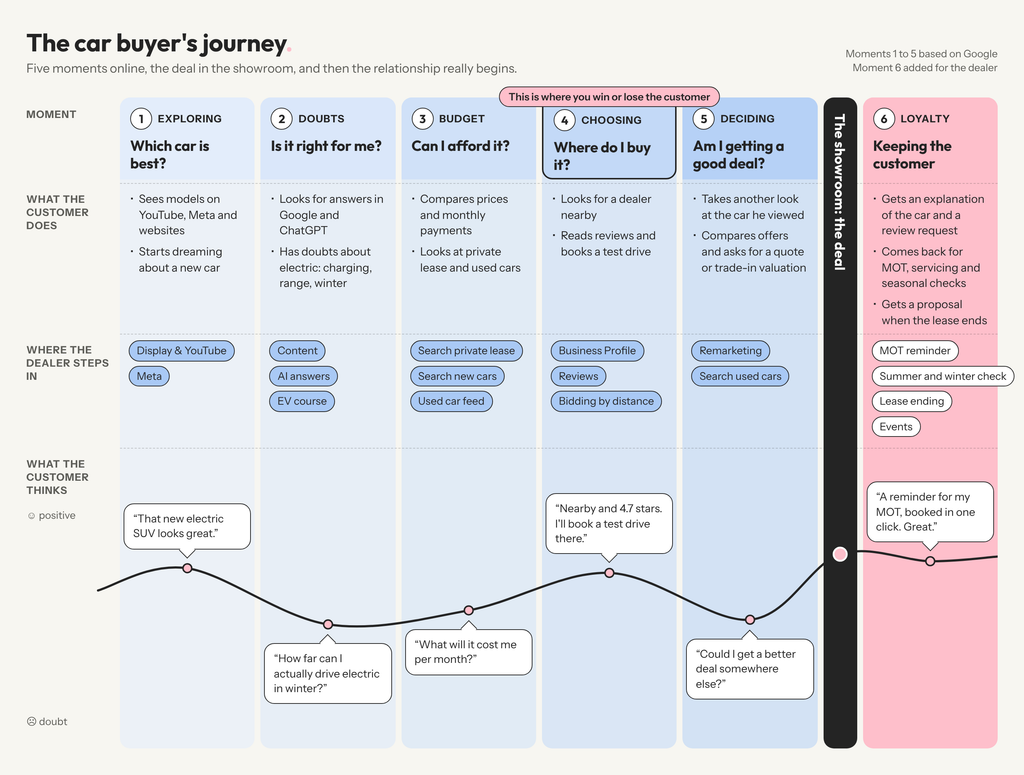
Google splits the car buying journey into five moments, and for each moment I looked at where the dealer can step in:
- Which car is best? – getting the dealer and its models in front of people before they start searching themselves.
- Is it right for me? – answering doubts, for example about driving electric.
- Can I afford it? – being visible with monthly payments and concrete prices.
- Where do I buy it? – easy to find locally, trustworthy and well reviewed. This is where the dealer wins or loses the customer.
- Am I getting a good deal? – bringing the doubter back with exactly the car he looked at.
And then there’s a sixth moment, one Google doesn’t mention but that might be the most important one for a dealer: keeping the customer. The relationship only really starts after the purchase. Every service, check, course and event brings the next purchase closer.
Three layers
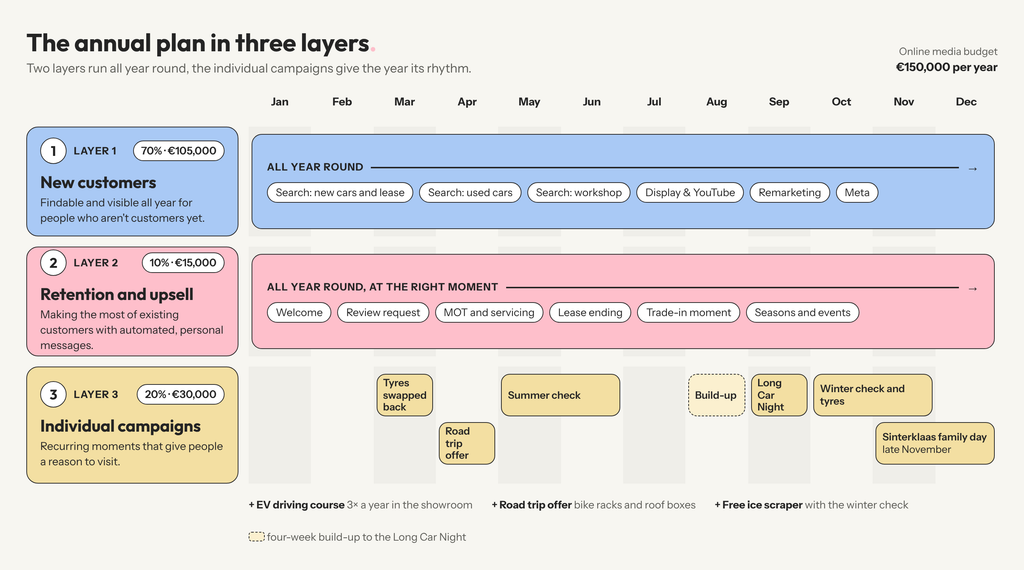
To cover all those moments, I build the plan in three layers. Each layer has its own role:
- New customers – findable and visible all year round for people who aren’t customers yet.
- Retention and upsell – making smart use of the existing customer base, with automated and personal messages.
- Individual campaigns – recurring moments that give people a reason to visit.
The first layer is the foundation and runs all year. The second layer gets more out of the customers you already have, and that’s almost always cheaper than reaching new people. And the individual campaigns give the year its rhythm: every time the customer thinks of the dealer, the dealer is a little more top of mind.
Layer 1: new customers
Being found and recommended, in Google and in AI
Search is changing. More and more people ask their question to ChatGPT or read the answer in Google’s AI Overviews. So the shortlist is no longer formed only in the ten blue links. That’s why in this layer I always work organically and paid.
Organically, it’s all about trust. AI tools and Google prefer to mention businesses with complete, consistent information and lots of good reviews. That means: a Google Business Profile per location that’s completely in order, an automatic review request after every delivery and every workshop visit, and content that answers real customer questions, such as “what does an MOT cost?” or “how far can I drive electric in winter?”. Paid makes sure you’re visible today, at the moment someone searches.
Search in four different campaigns
Search ads are the most direct way to capture demand from people looking for a car, a lease or a workshop. I split them into four campaigns, each with its own budget, keywords and landing pages:
- New cars – brand and model combined with buying words like “buy” and “test drive”, plus every new model as soon as it’s announced. People searching like this are in the final stage of the customer journey.
- Private lease – with the monthly price right in the ad, because lease shoppers compare on monthly cost.
- Used cars – linked to the stock via a feed. Every used car automatically gets its own ad with price and mileage, and once it’s sold, the ad stops by itself. Every day a used car spends less time on the lot saves money.
- Workshop – searches like “garage near me”, MOT and winter service, with a direct link to book an appointment online.
Not every click is worth the same. Someone 5 km from the location is more likely to drop by than someone 70 km away. That’s why I bid differently by distance, with a different radius per product: up to around 20 km for new cars, 40 km for used cars and 15 km for the workshop. People drive further for a used car, and least far for a service. Each location gets its own rings, so they don’t compete with each other.
Display, video and Meta: you also buy a car with your eyes
A car is a visual and emotional product. People look forward to it for a long time and work towards it. With display, YouTube and Meta, you make sure the dealer and its models are in view long before someone starts searching. This is how I see the division of roles: Meta and display make sure people know you, Google makes sure they find you.
- Display & YouTube – banners and video around the (new) models, in the region of the locations.
- Remarketing – the model or used car someone viewed back in view, with the price and a next step. The research phase takes weeks to months, and this keeps you on the shortlist.
- Meta – video and visual posts about models, used cars and the people behind the dealer. Familiar faces lower the threshold to the showroom.
With Meta I make one deliberate choice: no lead forms. In practice they often deliver low-quality leads, and those are of no use to the salesperson.
Layer 2: retention and upsell
This may well be the layer with the most opportunities, and the least exciting one to talk about. The dealer is sitting on a mountain of data. When is a customer’s MOT due? When does a lease contract end? Who bought a used car three years ago and may now be thinking about trading it in? You turn that knowledge into automated, personal messages:
- Welcome – after delivery an explanation of the car (extra useful for electric), a check-in after a few weeks, and then booking the first service.
- Review – two days after a delivery or workshop visit, asking whether the customer is happy, and if so, for a Google review.
- MOT and servicing – a reminder six weeks before the due date, with a direct link to book an appointment.
- Lease ending – nine, six and three months before the end of the contract: the options, new models and a test drive.
- Trade-in moment – from around two and a half years after purchase, a value estimate, the new models and an invitation to the Long Car Night.
- Seasons and events – the summer and winter check, swapping tyres back and the invitations to courses and events.
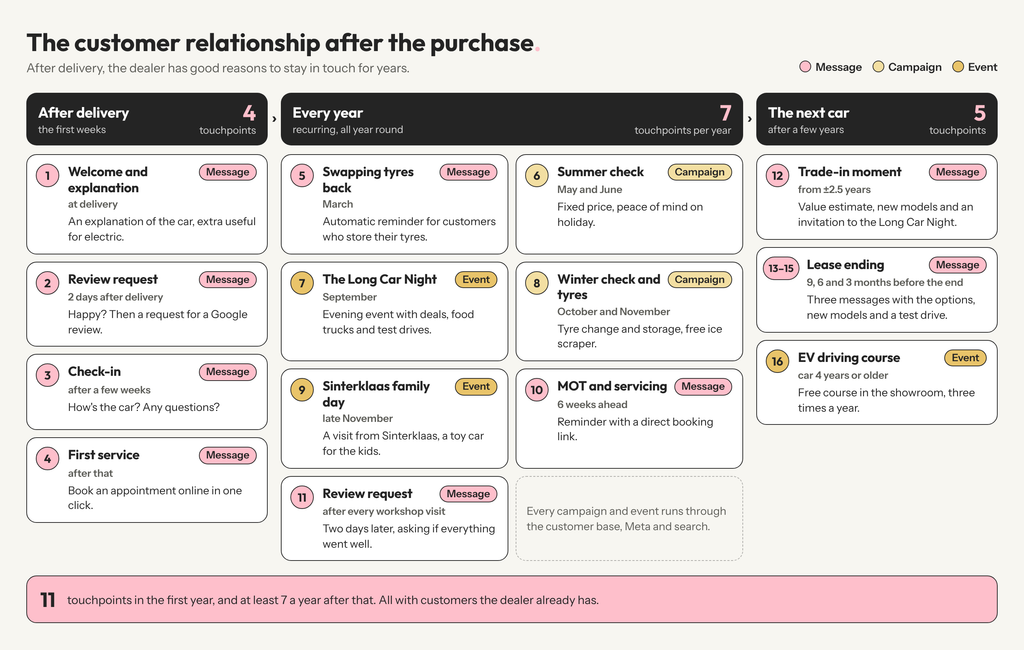
The MOT reminder is my favourite. The data is already in the dealer system, and a simple email with a booking link is the fastest workshop revenue there is.
Layer 3: individual campaigns
Individual campaigns generate revenue, but I mainly see them as touchpoints. Every campaign runs through search, Meta and the customer base.
Summer check and winter check
“Off to the south of France with peace of mind.” Nobody wants to be stuck with the family on the side of the Route du Soleil. With a fixed-price check in May and June, you’re mainly selling peace of mind, and you fill the workshop schedule in a quieter period.
“Ready for the first frost.” In October and November comes the winter check, with a tyre change and storage of the summer tyres. In March, the reminder to swap back goes out automatically. That’s how you build a regular tyre customer with two visits a year.
Two small product offers round it off: accessories for the road in April, such as bike racks and roof boxes, and in November a free ice scraper and screenwash with the winter check. It’s not about that bottle of screenwash, of course; the touchpoint is the goal.
Electric driving course
More and more people are considering electric, but they have questions. How does charging work at home and on the road? How do you plan a route to Austria? What does winter do to the range? A free course of an hour and a half in the showroom answers those questions, three times a year, with a maximum of 25 participants per evening.
The course is mainly aimed at existing customers with a car that’s four years old or older, supplemented with Meta in the region and search campaigns on questions like “benefits of driving electric”. You answer the question first, and only sell after that. That’s how you become the obvious place to make the switch.
The Long Car Night
This is the event I’m most excited about myself. A Friday evening in September, from 6 pm to midnight, American style. A lit-up showroom, food trucks, a DJ, a kids’ corner and every hour a new “deal of the hour”, live on the screens and online. Trade-in valuations on the spot, test drives in the dark, and at midnight all offers expire. Really.
The evening gets a four-week build-up: a “save the date” on Meta, a personal invitation to customers, a countdown clock on the website with the first deals, and on the day itself a final nudge via Meta, email and text message. September is a deliberate choice: the holidays are over, it’s far from the December rush, and the used car stock can still move before winter.
The Sinterklaas family day
Where the Long Car Night is about deals, the family day is about goodwill. Sinterklaas is the Dutch tradition of Saint Nicholas, celebrated in early December. On a Saturday at the end of November, customers drop by with their children. Sinterklaas comes to visit, every child goes home with a toy model car of the brand, and the parents get coffee, hot chocolate and a voucher for the winter check.
A fun afternoon with the kids builds a bond that no discount can buy. When people sign up, also ask for the children’s ages and the family’s car. Then you’ll also know when a bigger family car is needed.
The budget: €12,500 a month
The online media budget is €150,000 a year, or around €125 per car sold. I split it roughly like this:
| Item | Per month | Per year |
|---|---|---|
| Layer 1: new customers (approx. 70%) | €8,750 | €105,000 |
| Search: new cars & private lease | €2,500 | €30,000 |
| Search: used cars | €2,000 | €24,000 |
| Search: workshop | €1,250 | €15,000 |
| Display & YouTube | €1,000 | €12,000 |
| Remarketing | €750 | €9,000 |
| Meta | €1,250 | €15,000 |
| Layer 2: retention and upsell (approx. 10%) | €1,250 | €15,000 |
| CRM platform and content | €1,250 | €15,000 |
| Layer 3: individual campaigns (approx. 20%) | avg. €2,500 | €30,000 |
| Long Car Night | €10,000 | |
| Winter check & tyres | €6,000 | |
| Summer check | €5,000 | |
| Electric driving course (3×) | €4,500 | |
| Product offers (2×) | €2,500 | |
| Sinterklaas family day | €2,000 | |
| Total | €12,500 | €150,000 |
The split starts with the question of where the buying intent is. That’s why search gets the biggest share: that’s where you reach people at the moment they’re actively searching. Display, video and Meta are smaller, but make sure the dealer is already known before that search. You’ll see that reflected in more people searching directly for the dealer’s name.
To get a feel for what it delivers, I calculate cautiously with €50–70 per test drive, quote or trade-in request and €30–40 per workshop appointment. The sales budget in search is then good for around 800 to 1,000 requests a year, and the workshop campaign for around 400 appointments.
Important: this budget isn’t set in stone. In the first few months you’ll see where the search volume is and what delivers the most, and every quarter you shift money to the campaigns that work best.
Steering on what matters
Buying a car involves dozens of touchpoints. Attributing a sale to one campaign or one keyword gives a false sense of certainty. That’s why I look at the plan as a whole, on three levels:
- Soft conversions – signals of interest, such as phone calls, WhatsApp messages and route requests to the location.
- Hard conversions – requests that sales or the workshop can follow up on: test drives, quotes, trade-in valuations, workshop appointments and event sign-ups.
- Results – what it’s ultimately all about: cars sold, workshop revenue, customer satisfaction and the Google review score.
Those three come together in one monthly dashboard for management and marketing, so everyone is looking at the same numbers. After every campaign you record what worked, so the next summer check or Long Car Night gets even better. And don’t forget the basics: phone calls and WhatsApp clicks are often invisible, while that’s exactly where a lot of contact starts in automotive. What you don’t measure, you can’t steer.
In closing
If I had to sum up the plan in one sentence: make sure you’re findable all year round for new customers, get more out of the customers you already have, and give people a good reason to drop by a few times a year.
This plan is an example. Every brand, every region and every customer base calls for its own choices, and that’s exactly what makes it fun to work out a plan like this together. Do you work in automotive and fancy a chat about where the biggest opportunities are for you? Feel free to send me a message or plan an introduction via pocpoc.nl.